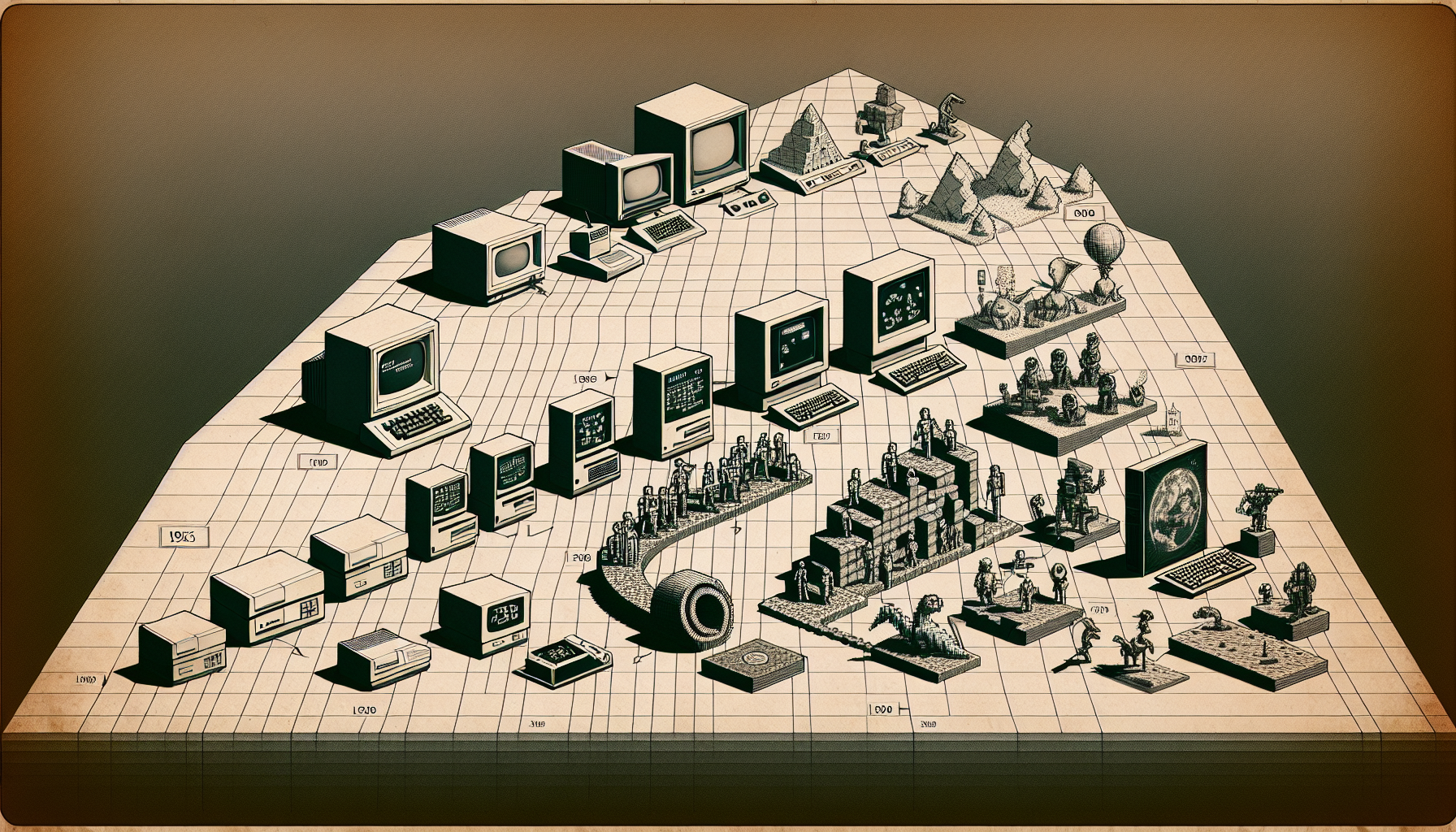
The Evolution of Online Gaming: From Text-Based Adventures to Immersive Worlds
Early Beginnings: MUDs and Text-Based Adventures
The genesis of online gaming can be traced back to the late 1970s and early 1980s with Multi-User Dungeons (MUDs), primarily text-based games that combined elements of role-playing, puzzle-solving, and exploration. These games operated on mainframes and required players to connect via dial-up modems, navigating through richly crafted narratives driven solely by text. Pioneers like MUD1, created by Roy Trubshaw in 1978, and later MUSH and MOOs incorporated social interaction along with gaming mechanics.
The simplicity of MUDs allowed for a unique form of storytelling and community-driven gameplay. Players engaged in imaginative role-play, collaborating to solve challenges using text commands. These foundational elements sparked a revolution in interactive entertainment, setting the stage for future online gaming platforms.
The Rise of Graphical User Interfaces
The evolution from text to graphics marked a significant milestone in online gaming history. As technology advanced, early graphical games began to emerge in the late 1980s and early 1990s. Games like Neverwinter Nights in 1991, released on AOL, were some of the first to utilize a graphical interface, offering players the ability to interact in a three-dimensional space.
This transition was made possible by the increasing availability of personal computers and better internet connections, allowing players to experience a richer environment with a more captivating narrative. However, due to the limitations of graphic design and internet speeds, early graphical games retained a level of simplicity, with basic animations and limited color palettes.
The Internet Boom and Massively Multiplayer Online Games (MMOs)
The mid to late 1990s saw the birth of Massively Multiplayer Online Games (MMOs), which further reshaped the landscape of online gaming. Titles such as Meridian 59 and Ultima Online utilized the burgeoning capabilities of the internet, allowing thousands of players to interact in a persistent online world.
advertisement

These MMOs introduced complex economies, player-versus-player (PvP) combat systems, and extensive customization options for characters and environments. The social aspect of these games culminated in the formation of guilds and communities, which are still prevalent in modern gaming cultures. Ultima Online set precedents for player freedom and quest narratives, becoming a benchmark for future online games.
The World of Warcraft Phenomenon
The release of World of Warcraft (WoW) in 2004 was a watershed moment in the evolution of online gaming. Developed by Blizzard Entertainment, WoW redefined the MMORPG genre through its immersive world-building, rich lore, and accessible gameplay mechanics. The game’s vast landscapes, detailed quests, and intricate social systems drew millions of players globally, becoming a cultural phenomenon.
Players could explore, raid dungeons, or engage in PvP battles across expansive continents. WoW’s interface set a standard for user experience in online gaming, incorporating intuitive elements that catered to both newcomers and veteran gamers. The game’s creative design led to the establishment of esports, as some players began competing in professional settings.
The subscription model introduced by WoW also became a blueprint for monetization in online gaming, leading to subsequent titles adopting similar structures to generate revenue.
The Transition to Free-to-Play and Microtransactions
As the gaming industry matured, the landscape shifted once again with the rise of free-to-play models in the late 2000s and early 2010s. Games like League of Legends and Dota 2 demonstrated a new business strategy, offering free access to the base game while monetizing through in-game purchases, cosmetics, and battle passes.
This model enabled developers to reach a broader audience and foster player bases that could grow more organically. However, it raised debates concerning player equity and fairness, particularly around pay-to-win mechanics. The importance of clear communication, community engagement, and player satisfaction became more pronounced than ever as developers navigated this new landscape.
Technological Innovations: Graphics and Gameplay Mechanics
The enhancements in hardware technology significantly influenced the evolution of online gaming. Enhanced graphics processing units (GPUs), faster internet speeds, and improved server infrastructure allowed developers to create expansive, intricate games with stunning visuals, such as The Elder Scrolls Online and Final Fantasy XIV.
Virtual Reality (VR) and Augmented Reality (AR) technologies introduced entirely new avenues for gaming experiences. Platforms like Oculus Rift and games such as Pokémon GO showcased the possibilities of immersive gaming, merging the physical world with digital interactivity.
Streaming technologies, aided by platforms such as Twitch and YouTube Gaming, revolutionized how gamers shared content, turning gameplay into a social experience. These developments offered gamers opportunities not only for passive entertainment but also for active participation, building communities based around shared experiences.
Cross-Platform Play and Social Connectivity
The late 2010s ushered in an era of cross-platform play that emphasized inclusivity in gaming. Titles like Fortnite and Minecraft allowed players on different consoles and devices to interact seamlessly, promoting a more united gaming community. This shift illustrated the importance of fostering social connections, as players increasingly sought collaborative and competitive experiences irrespective of their platform.
Games began to encompass not only mechanics and narratives but also strong social elements that encouraged friends to play together, blurring the lines between gaming and social networking. This engagement led to the birth of gaming events and conventions, further solidifying gaming as a dominant facet of modern culture.
The Influence of Streaming and Content Creation
As gamer influence grew, so too did the impact of streaming and content creation on the evolution of online gaming. Platforms like Twitch transformed gameplay into a spectator sport, where professional gamers attracted large audiences and began influencing market trends. These streamers cultivated communities, providing a space for fans to engage with each other and their favorite players.
This shift encouraged game developers to integrate features that enhance spectator involvement, such as interactive elements that allow viewers to influence gameplay in real-time. The synergy between gaming, content creation, and live streaming has hardened the game’s role as a significant entertainment medium in contemporary society.
Future Trends: AI and Machine Learning in Gaming
As technology continues to progress, the incorporation of Artificial Intelligence (AI) and Machine Learning (ML) into gaming promises to enhance player experiences dramatically. These technologies can create more responsive, personalized narratives and intelligent NPC interactions that adapt based on player choices.
Moreover, we can anticipate the emergence of procedurally generated worlds that are continually evolving, offering endless exploration opportunities. As developers experiment with these technologies along with innovations in cloud gaming and 5G connectivity, gamers can expect even richer and more immersive online experiences.
The Global Gaming Community
Today, online gaming transcends geographical boundaries, uniting players from diverse backgrounds. According to recent statistics, billions of gamers globally participate in various online games, crafting unique cultural phenomena centered around gaming. Language barriers have been mitigated by collaborative gameplay, and esports has cemented its place as a formidable, competitive global industry.
Online gaming has not only changed the way individuals view entertainment but has also influenced social interactions and community-building. As the industry continues to evolve, it reflects broader societal trends and cultural shifts, allowing players to connect in ways previously unfathomable.
The Cultural Impact of Online Gaming
The evolution of online gaming reflects significant cultural shifts over the years. From the early days of text-based adventures to today’s richly immersive 3D environments, gaming has influenced and intersected with mainstream culture, gaining acceptance as a legitimate art form and medium of storytelling.
As games tackle more profound themes—ranging from identity to social justice—developers harness the power of stories to comment on the human experience. Titles such as Celeste and The Last of Us have led the charge, addressing mental health and moral dilemmas within interactive frameworks, encouraging players to engage with these issues thoughtfully.
As online gaming continues to evolve, its narratives, mechanics, and community dynamics will shape not just the gaming landscape but the broader cultural milieu in which they exist. This evolution encapsulates the growth from simple text commands to intricate worlds filled with opportunities for social interaction and profound experiences. The journey of online gaming is a testament to innovation, creativity, and the human capacity for connection through play.
advertisement