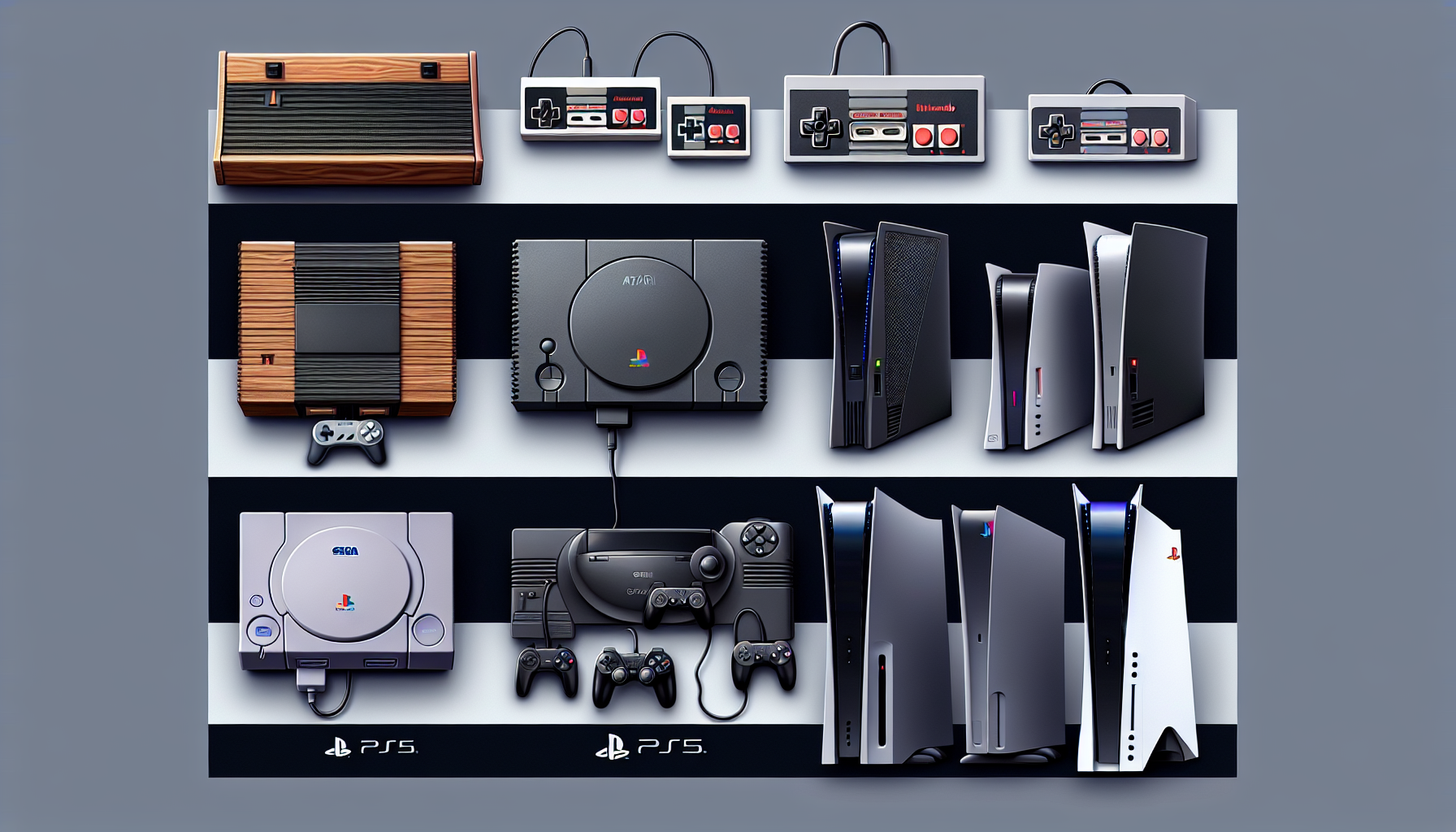
The Evolution of Home Consoles: From Atari to PS5
The Birth of Home Consoles: Atari 2600
In 1977, Atari revolutionized gaming with the release of the Atari 2600, the first home console that allowed players to insert interchangeable cartridges. With a modest 128 bytes of RAM and the capacity to play a variety of games, the Atari 2600 offered classic titles such as “Pong,” “Space Invaders,” and “Adventure.” This technology marked a significant shift from arcade gaming to home entertainment, laying the groundwork for future consoles.
Key Features of the Atari 2600
- Cartridge System: The ability to play multiple games broadened the audience for serious home gaming.
- Joystick Controller: The simple joystick and button design felt more intuitive at home than arcade controls.
- Graphics Limitations: The 8-bit graphics were rudimentary, but they paved the way for creativity in game design.
The Rise of 8-Bit Era: Nintendo Entertainment System (NES)
Following the video game crash of 1983, the industry saw Nintendo revitalize the market with the NES in 1985. This console embraced 8-bit graphics and introduced iconic characters like Mario and Link. The NES popularized the concept of a more comprehensive gaming experience, setting the bar for future consoles.
Key Innovations of the NES
- High-Quality Games: Titles like “Super Mario Bros.” and “The Legend of Zelda” showcased narrative and design depth.
- Improved Graphics: With a richer color palette and better sprites than Atari, players experienced more immersive environments.
- Third-Party Development: Nintendo established a licensing system for third-party developers, allowing innovation while maintaining quality control.
The 16-Bit Revolution: Sega Genesis and Super Nintendo Entertainment System (SNES)
The late 1980s brought about the 16-bit consoles, marked by the Sega Genesis (1988) and the Super Nintendo Entertainment System (SNES) (1990). These systems introduced enhanced graphics and sound, making games more captivating.
Sega Genesis
- Faster Processors: Allowed smoother animations and gameplay mechanics.
- Sonic the Hedgehog: This title became Sega’s mascot, highlighting speed-based gameplay and vibrant graphics which rivaled Nintendo.
- Introduction of Sports Titles: Games like “Madden NFL” popularized sports gaming culture.
Super Nintendo Entertainment System (SNES)
- Mode 7 Graphics: Enabled pseudo-3D graphics, enhancing the visual experience of racing games like “F-Zero”.
- RPGs Flourished: The genre exploded with classics like “Final Fantasy VI” and “Chrono Trigger”.
The CD Era: Sony PlayStation and Sega Dreamcast
With the arrival of the 32/64-bit era, Sony entered the gaming market with the PlayStation in 1994. This was a pivotal moment as it introduced CD-ROM technology, allowing for larger game files and more complex audio-visual experiences.
Sony PlayStation
- 3D Graphics: The PlayStation’s capability to render 3D environments was revolutionary for adventure and action games.
- Diverse Game Library: Titles like “Final Fantasy VII” and “Metal Gear Solid” transformed narrative storytelling in games.
- User-Friendly Design: The console’s interface made it accessible for a broad audience, which helped it dominate the market.
Sega Dreamcast
- Early Online Play: Released in 1999, the Dreamcast introduced online gaming with titles like “Phantasy Star Online”.
- Visual Memory Unit (VMU): An innovative memory card that acted as a second screen for certain games, enhancing user experience.
The Era of 128-Bit: PlayStation 2 and Xbox
The early 2000s witnessed the next leap in console technology with the introduction of the PlayStation 2 in 2000 and Microsoft’s Xbox in 2001. This period witnessed enhancements in graphics, online gameplay, and multimedia capabilities.
advertisement

PlayStation 2
- Backwards Compatibility: The PS2 could play PS1 games, offering existing gamers value.
- DVD Playback: Doubling as a DVD player, it appealed to non-gamers and contributed to its commercial success.
- Online Play Introduced: While limited, it began to set the stage for the online gaming future.
Xbox
- Robust Online Infrastructure: Microsoft’s Xbox Live launched in 2002, vastly improving multiplayer capabilities and community interaction.
- Halo Franchise: The launch title “Halo: Combat Evolved” became a defining game for the Xbox, establishing a successful franchise.
The High-Definition Era: Xbox 360, PS3, and Wii
The launch of the Xbox 360 in 2005, PlayStation 3 in 2006, and Nintendo Wii in 2006 created a competitive and varied landscape in gaming.
Xbox 360
- HD Graphics: The console supported high-definition graphics, elevating the visual experience.
- XBL Arcade: In addition to traditional games, downloadable indie titles flourished on Xbox Live.
- Social Features: Introduced achievements and avatars, fostering social interaction.
PlayStation 3
- Blu-ray Technology: The PS3’s inclusion of a Blu-ray player marked a technological shift and an edge over competition.
- Free Online Play: Game and multimedia content accessible without charges attracted players.
- Expanded Library: Titles like “Uncharted” and “God of War III” showcased technological prowess.
Nintendo Wii
- Motion Controls: The Wii Remote allowed players to interact physically, ushering in new gaming experiences targeting casual gamers.
- Family-Friendly Games: Titles like “Wii Sports” attracted a diverse audience, creating new gaming demographics.
The Modern Era: Xbox One, PS4, and Nintendo Switch
In the 2010s, the gaming landscape was marked by an emphasis on social gaming, indie titles, and immersive 4K graphics with the releases of Xbox One, PS4, and Nintendo Switch.
Xbox One
- Multimedia Integration: Microsoft promoted Xbox One as an all-in-one entertainment system, merging gaming, television, and streaming.
- Backward Compatibility: This feature allowed players to enjoy titles from previous Xbox consoles.
- Game Pass: Xbox Game Pass introduced subscription-based access to a rich array of titles, shifting gaming consumption models.
PlayStation 4
- Powerful Hardware: The PS4 offered improved hardware, allowing for stunning graphics and fluid gameplay.
- Share Feature: Players could stream gameplay directly to platforms like Twitch and YouTube, improving community engagement.
- Stellar Exclusives: Titles such as “The Last of Us Part II” and “Spider-Man” solidified its status as a leader in gaming.
Nintendo Switch
- Hybrid Functionality: Merging handheld and home console gaming created a versatile platform for gamers on the go.
- Innovative Titles: Games like “The Legend of Zelda: Breath of the Wild” redefined open-world gameplay.
- Focus on Indie Games: The Switch provided a platform for independent developers to thrive, enhancing its game library.
The Latest Generation: PlayStation 5 and Xbox Series X|S
The most recent evolution in gaming technology, the PlayStation 5 and Xbox Series X|S, launched in late 2020, elevating the gaming experience through cutting-edge hardware and features.
PlayStation 5
- Ultra-Fast SSD: This significantly reduced load times, allowing for seamless gameplay within expansive worlds.
- DualSense Controller: The innovative controller offered adaptive feedback and advanced haptics, intensifying the gaming experience.
- Expanded Gaming Library: The PS5 provides access to a wealth of titles, both exclusive and cross-platform.
Xbox Series X|S
- Incredible Performance: With powerful hardware designed to support 4K gaming, the Series X offers immersive experiences.
- Quick Resume: The ability to switch between multiple games with minimal loading enhances user convenience.
- Game Pass Expansions: Continual growth of the Game Pass library ensures players have direct access to an extensive library.
Future Trends in Home Consoles
As home consoles progress, several trends are emerging. The push towards cloud gaming is transforming how players access and experience games, minimizing the need for physical hardware. The concept of constantly updating hardware and software through digital downloads may revolutionize traditional console generation cycles. Meanwhile, advancements in virtual and augmented reality are opening new frontiers in gameplay, ensuring the evolution of home consoles remains dynamic and engaging in the coming years.
advertisement